
Siena Cathedral: Culture and Tradition
Siena is culture and tradition. The City of the Palio cannot exist without its history. Nannini has been part of this story since the early 1900s; with our traditional recipes, we pass down our city's culinary tradition from generation to generation. We care about promoting Siena's reputation, and we believe that to truly savor our recipes, you need to know Siena, in all its nuances.

Siena Cathedral: The Exterior
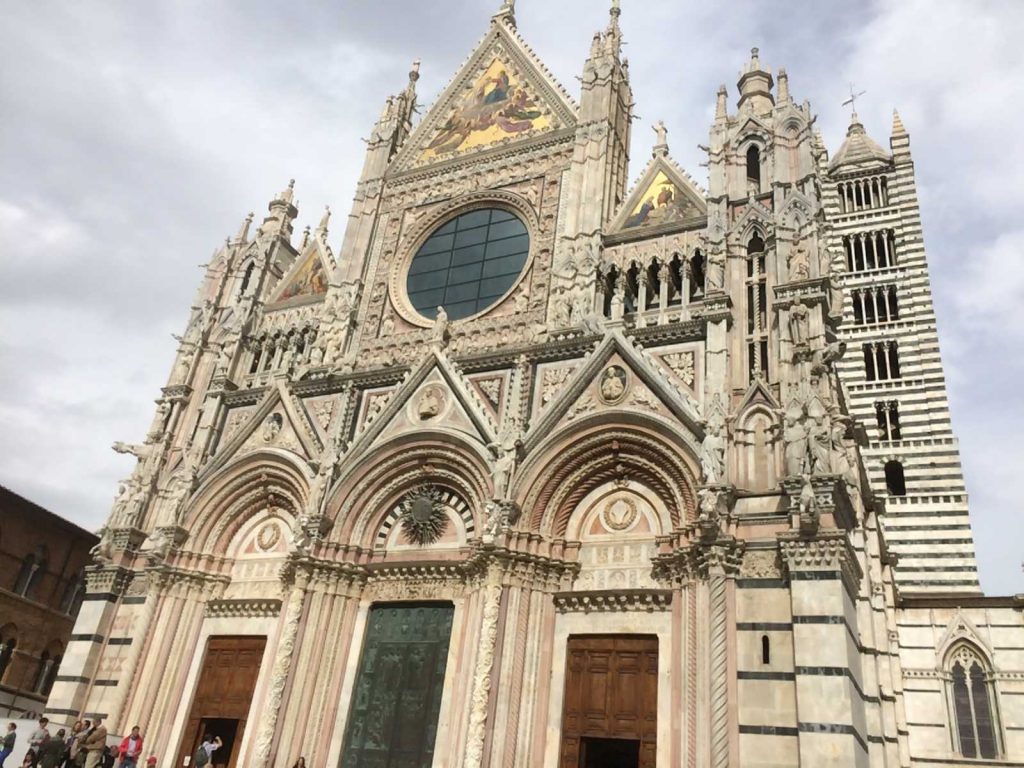
Siena Cathedral is located in the heart of the city center. Situated in the square of the same name, it displays all its beauty and grandeur. Characterized by an Italian Romanesque-Gothic style, the Duomo is composed of the central cathedral building with its dome, bell tower, baptistery, and "Facciatone."
The structure is built on a Latin cross plan with three naves. The exterior is characterized by alternating bands of white Carrara marble and black/greenish serpentine marble from Prato. This clearly evokes the "balzana," Siena's historic coat of arms.
According to tradition, the Cathedral of Santa Maria Assunta was built in the 9th century to replace another church dedicated to Mary. Tradition also holds that it was later consecrated by the Sienese Pope Alexander III Bandinelli.

The cathedral and bell tower were already built in 1264. In 1317, work began on expanding the cathedral toward Via Vallepiatta and the Baptistery. In 1339, the Sienese decided that this building was insufficient and needed to be expanded to create an even larger complex. This was fueled by rivalry with nearby Florence and its Santa Maria del Fiore.
Unfortunately, the project was never completed due to the plague of 1348, which left Siena in a deep economic crisis. Furthermore, the poor condition of the land made it impossible to accommodate a project of such scale. What was to have been the "Duomo Nuovo" therefore never saw the light of day. What remains is the so-called "Facciatone," nothing more than a skeleton with pillars and a façade. The upper section of the "Facciatone" is open to visitors and offers a wonderful panoramic view of the city of the Palio.
Siena Cathedral: the floor
If the exterior isn't enough, Siena Cathedral hides even more wonders inside. The symmetrical geometry of the white and black/greenish bands on the exterior continues inside, where you can admire sculptures created by some of the most important sculptors of all time. Nicola Pisano, Donatello, and Michelangelo, to name just a few, are just a few.
Upon entering the Cathedral of Santa Maria Assunta, one cannot help but notice the floor. This work is a hymn to beauty. Composed of 56 marble panels, it was created over the centuries. The project, in fact, began in the 14th century and was completed in the 19th century thanks to the intervention of various artists, all Sienese, except for the Umbrian Pinturicchio. The techniques used to finish this masterpiece are inlay marble and graffito.
Giorgio Vasari himself was fascinated by this work, defining it as the most beautiful and magnificent ever to exist.
“the most beautiful…, largest and most magnificent… that had ever been made.”Giorgio Vasari
To fully appreciate the magnificent beauty of Siena Cathedral, there is the “Gate of Heaven” route, which allows you to see the wonders inside and outside the church from a different perspective.
This route allows you to reach the top of the building and peer out over the starry vaults. This way, you can admire fantastic views both inside and outside the cathedral. These areas were long closed to the public, and only master architects were allowed to enter.
Siena Cathedral: Piccolomini Library
The Cathedral of Santa Maria Assunta also houses the little gem of the Piccolomini Library, a work within a work of art. This building houses a cycle of frescoes of great pictorial quality by Pinturicchio depicting ten episodes from the life of Pope Pius II.
This extremely rich space was commissioned by Cardinal Francesco Todeschini Piccolomini, Archbishop of Siena who later became Pope Pius III, in memory of his maternal uncle Pope Pius II. It is located along the northwestern side of the Cathedral where the old rectory once stood.
The library houses the series of manuscripts collected by Pope Pius II, surrounded by frescoes created in Pinturicchio's workshop between 1503 and 1508. Bright colors and a refined technique characterize these painted walls.
This series' theme recounts the key moments in the pope's life, such as when he became a cardinal or a pope. A particularly important fresco is the one depicting the meeting between Emperor Frederick III and Eleanor of Portugal, facilitated by Pope Pius II. The events are depicted in rigorous historical sequence and with meticulous attention to detail.
At the center of the vault, we also find the symbol of the Piccolomini family. The room is further enhanced by a sculpture depicting the Three Graces, also commissioned by Pope Pius III and purchased by the Cardinal of Rome.
Siena Cathedral is ethereal in its beauty and deserves to be admired in every inch. Every corner of this place was designed to be adorned with immeasurable beauty. Talking about it doesn't do it justice. Seeing it with your own eyes is the only way to grasp its true essence.
A tour of the Cathedral of Santa Maria Assunta requires time, and after an intense immersion in its history, a little refreshment in another iconic Sienese spot can be a welcome relief. Come enjoy a coffee or a pastry at one of our Nannini cafés; we look forward to sharing our Siena with you.